Skip to content

Home / Guides / Flying with pets

Your dog can fly. The dates are the hard part.

Operators who publish the figure put it at roughly one private flight in five carrying an animal, and almost every enquiry about it asks the wrong question. People ask whether the aircraft will take a dog. It will. What decides whether the animal travels is a blood test taken months earlier — and no aircraft, price or operator can shorten that clock.

The short answer

The aircraft is never the problem. The calendar is.

Most dogs that already travel can fly next week

If the rabies vaccination has been kept valid with no gap between boosters, and an acceptable antibody result is already recorded in the passport, neither the test nor the waiting period is asked for again — by Türkiye or by the EU. Bring the passport and the original certificate and the date is yours to choose.

It is the lapsed booster that costs months

A booster given after the previous one expired counts as a first vaccination, and the whole chain restarts: 30 days to the blood test, then three months to the border. An unvaccinated dog is four to five months from Europe. This is the only part nobody can shorten.

Which one you are in is decided by one date — the day of the last rabies booster, and whether the one before it had expired. Send us that date and we will tell you in the first reply.

A rabies antibody blood test taken today does not let your dog enter the European Union or Türkiye for three months. For Japan and Australia the wait is 180 days. And the blood sample itself cannot be taken until at least 30 days after a first rabies vaccination — so an unvaccinated dog is realistically four to five months from entering the EU, and seven to eight months from entering Japan.

This is the whole reason the page exists. If you are flying in six weeks and the vaccination has not been done, the animal cannot travel legally to those destinations, and we would rather tell you that today than sell you a flight you will have to unwind. The one thing we will not do is put you on an aircraft and let you discover it at the border.

This page is planning information, not veterinary or legal advice. Requirements are set by the authority of the country you are entering and they change. Before any flight we check the current rule against that authority for your specific date and animal, and put what we find in writing.

The chain, in order

Five steps, and each one can only start when the last is finished.

The order matters as much as the dates. A rabies vaccination given before the microchip does not count, and has to be given again — the single most common and most expensive mistake in this process.

An EU pet passport open beside a laboratory certificate and a microchip scanner, with a dog waiting at the edge of the table
The microchip, the vaccination record, the titration certificate. This is the part that takes months.
StepWhat it isTiming
1. MicrochipISO 11784 / 11785 transponder, 15-digit code, read by a standard scanner.Same day
2. Rabies vaccinationMust be given after the microchip, or it is not recognised. A booster given after the previous one expired counts as a first vaccination — this is what restarts everything below.Valid from day 21
3. Blood sampleAntibody titration test, taken by an authorised vet, analysed by an approved laboratory. Must show at least 0.5 IU/ml.30 days after step 2
4. The waitCounted from the date the blood was drawn, not from the result. This is the step that decides your date.3 months, or 180 days
5. Health certificateIssued close to departure and short-dated. Some destinations also need an import permit obtained in advance.Days, not months

Step 4 is why this cannot be bought, expedited or argued with. The wait exists to prove the animal was not already incubating rabies when it was vaccinated, and each authority has made its own judgement about how long that takes — 180 days at the cautious end, three months where the exporting country's own rabies control counts for something. It is a regulatory window, not a biological constant, which is why the same dog meets two different numbers. What does change the arithmetic: an animal whose rabies vaccination has been kept continuously valid, with no lapse between boosters, does not repeat the blood test or the wait at all. Keeping the booster current is worth more than any amount of planning later.

By destination

The same dog, five different answers.

EnteringWait before entryAlso required
European Union3 monthsApplies when arriving from a country not on the EU list — Türkiye is one. Titration not needed at all for movements between EU states, or for return to the EU if compliance was established before leaving.
Türkiye3 monthsSame structure as the EU: ISO microchip, at least 0.5 IU/ml, analysis by an EU-approved laboratory, entry at the earliest three months after the sample date. The test is not asked for again where the passport records an acceptable titre and the vaccinations have been kept regular; and a Turkish-origin animal returning home with a result taken before it left is not held to the three months at all. Maximum two animals per passenger — two cats, or one cat and one dog. Passport, the original titration certificate and the health certificate are all produced at the border.
United Arab Emirates21 days from vaccinationImport permit from the Ministry of Climate Change and Environment, valid 90 days, obtained before you fly. Maximum two cats, or two dogs, or one of each, per year. Titration test required from countries the UAE classes as high risk for rabies. A list of dog breeds is banned outright.
Japan180 daysAdvance notification to the Animal Quarantine Service at least 40 days before arrival. A notification filed later than that is, in principle, not accepted — the flight is not the deadline, the notification is.
Australia180 daysCounted not from the day the blood is drawn but from the day it reaches the laboratory, and there are no exceptions. An identity check must be completed before the blood test and cannot be done at the same visit. Import permit required, then 10 to 30 days in the Mickleham quarantine facility on arrival. Plan this in quarters, not weeks.

Puppies and kittens under three months and unvaccinated are handled case by case, against the rabies status of the country they are coming from — ask before you plan around one. Checked against the European Commission, the Turkish Ministry of Agriculture and Forestry, the UAE Ministry of Climate Change and Environment, Japan's Animal Quarantine Service and Australia's Department of Agriculture, Fisheries and Forestry on 14 September 2026. Where a figure is not in this table, we do not have it from the authority itself and will not print it.

The Gulf: the breed list, and the two-animal limit

Two rules that end trips at the ramp

The breed list, and the two-animal limit.

Both are knowable a month in advance, and both are absolute.

The banned breeds. The UAE prohibits import of, among others, the American Pit Bull Terrier, Staffordshire Bull Terrier, American Staffordshire Terrier, American Bully, Cane Corso, Boerboel, Bullmastiff, Neapolitan Mastiff, French Mastiff (Dogue de Bordeaux), Brazilian Mastiff (Fila Brasileiro), Argentinian Mastiff (Dogo Argentino), Tibetan Mastiff, Bully Kutta and Perro de Presa Canario. There is no permit route around this and no discretion at the border. If the passport says one of these words, the answer is no — and it is better to learn that from us in writing than from an inspector with the aircraft on the stand.

The annual limit. Personal import is capped at two cats, or two dogs, or one of each, per year — separate from the movement of animals already resident in the country. A family moving three dogs is not a scheduling problem, it is a structural one, and it needs to be raised before anyone books.

The permit has a shelf life. Ninety days from issue. Pulled too early it expires before you fly; left too late it is not there when you need it. It sits in the middle of the plan, not at either end.

Saudi Arabia and Qatar each run their own permit and health-certificate regimes with their own documents and their own lead times. We confirm the current requirement with the destination authority for your date rather than working from what was true last season.

The breed list and the annual limit are published by the UAE Ministry of Climate Change and Environment; checked 14 September 2026. Saudi and Qatari requirements are confirmed case by case and are deliberately not listed here.

On the day

In the cabin, with you. That is the whole point.

Private charter

Cabin · with you

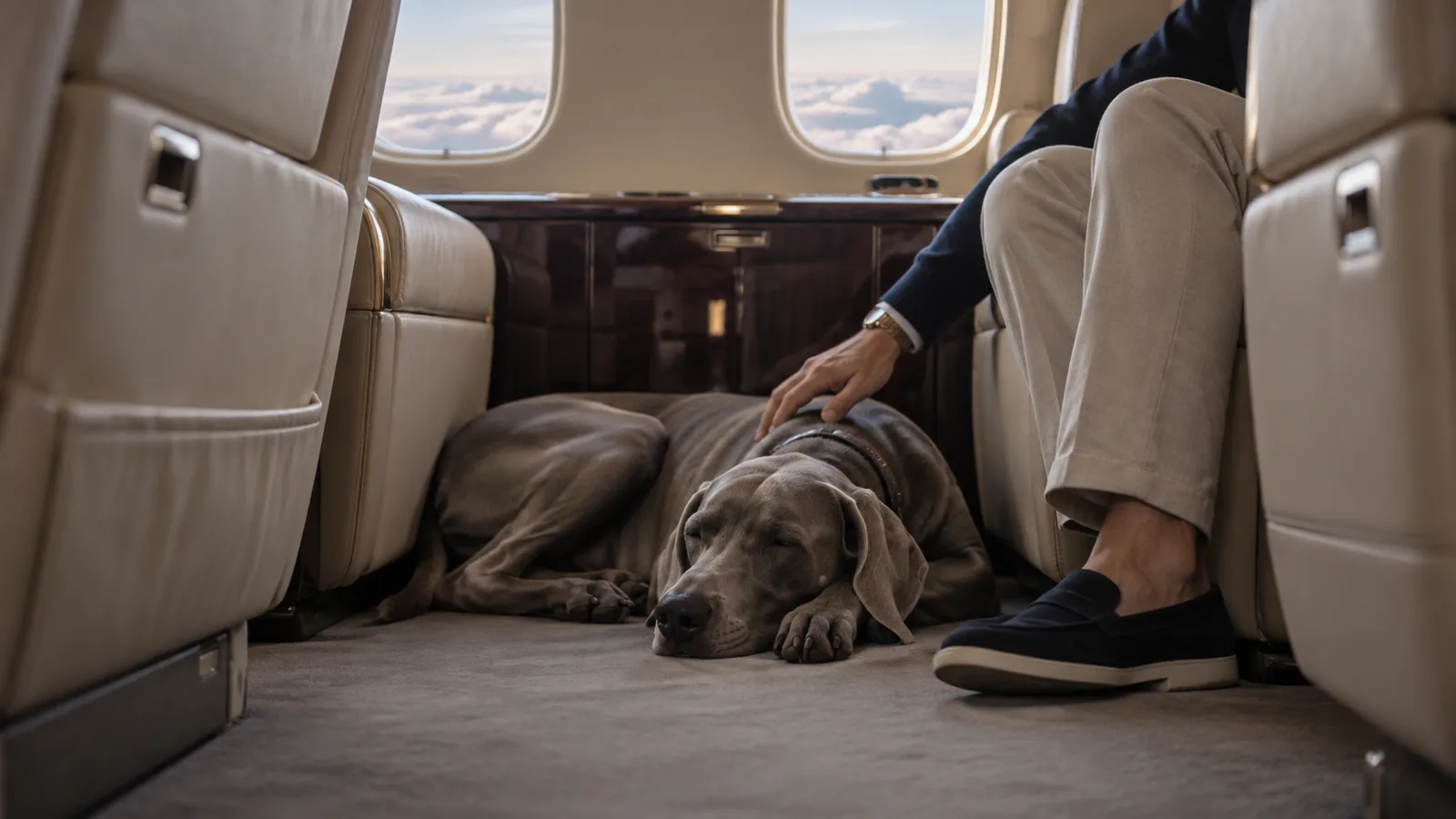
The animal travels in the cabin, not in a hold, with no separate check-in and no transfer through a cargo terminal. For an older dog, a nervous one, or one that simply cannot be shipped as freight, this is the reason the flight is being chartered at all.

What is still not automatic

Operator's aircraft · operator's rule

Acceptance is the operator's decision, and a few decline animals on particular aircraft or particular interiors. We ask before we quote, not after, and the answer — with any cleaning charge — goes on the quotation in writing.

A dog asleep on the cabin floor between two seats in flight, a passenger's hand resting on its back
In the cabin, on the floor, asleep. No hold, no cargo terminal, no separate check-in.

What we ask you for at enquiry, so the first reply is a real one: species and breed, weight, the microchip number, the date of the last rabies vaccination, whether a titration test has ever been done and on what date the blood was taken. Those six facts decide whether your date is possible. Everything else can follow.

What we actually do

We run your calendar backwards.

From your date, not from today

We start at the date you want to land and count back through the five steps. That gives one of two answers: the latest day each step can happen, or the earliest date the animal can legally arrive. Both are useful. Only one of them is what you hoped for.

The honest no

If the dates cannot be met we say so, in the first reply, before any discussion of aircraft. We would rather lose the booking than have an animal turned back at a border — that outcome costs you a quarantine, and costs us the client anyway.

The documents, checked against the authority

Microchip, vaccination record, titration certificate, health certificate, import permit. We check them against the destination authority's current requirement for your date, and tell you what is missing while there is still time to fix it.

One more thing worth saying plainly: if your dates are fixed and the clock has not been started, no operator and no broker can fix this, ours included. The only real remedy is starting the chain early — which costs a vet visit and nothing else.

Send the dates

Tell us the route, the date and the animal. Priced options in under two hours.

The operator named, the aircraft type, one figure with the inclusions listed — and a straight answer on whether the paperwork can be ready in time. If it cannot, that answer comes first.

Request aircraft options → go@aeroinis.com

Read alongside what a charter costs and the Charter Agreement. We do not sell seats: the aircraft is chartered as a whole, by you.