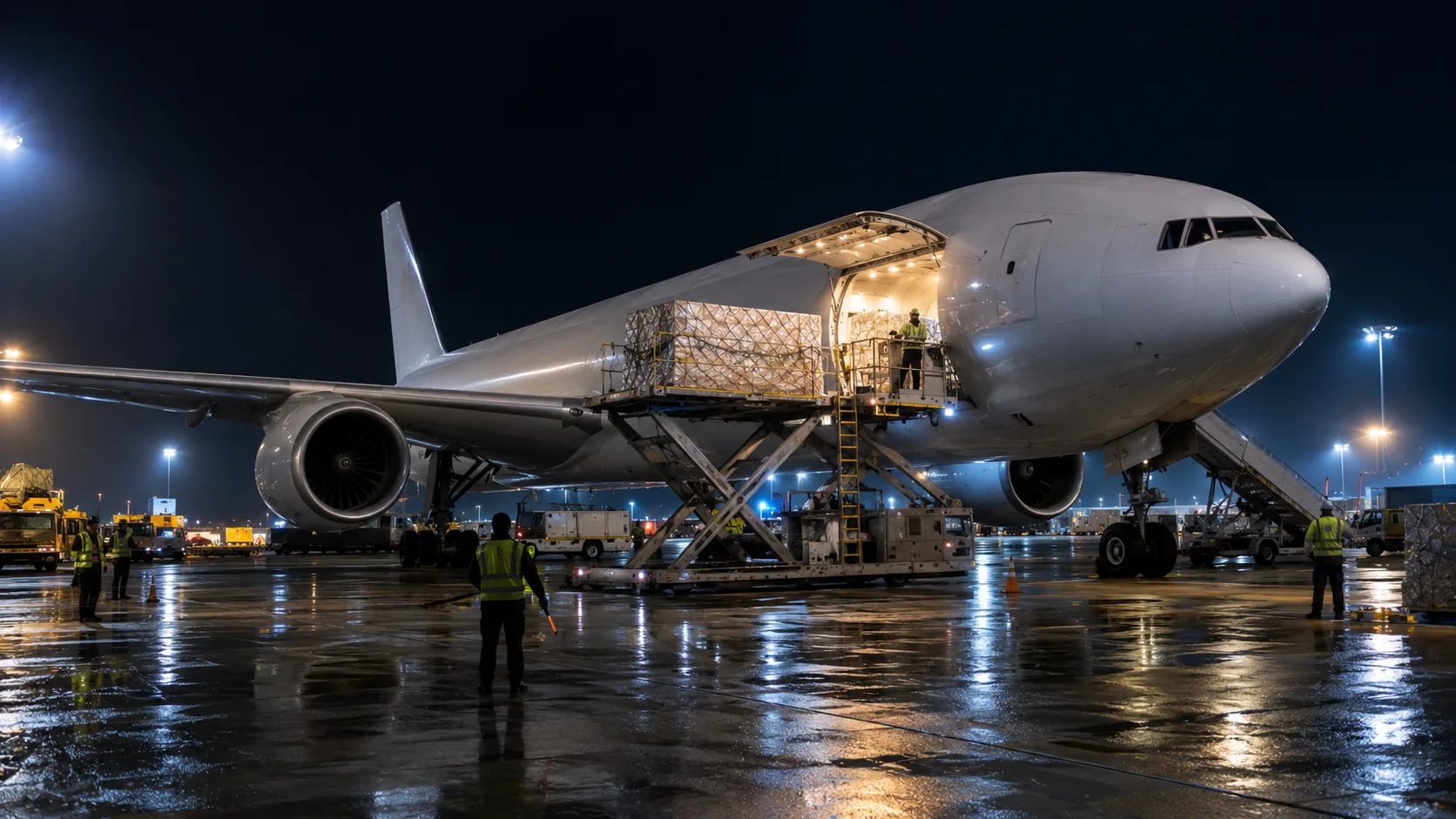

Cargo charter · a full aircraft, one shipment
From a sealed envelope to a 100-tonne press. Send the dimensions, get a quote.
Documents that cannot be emailed, a part that stops a line, a machine no schedule will take. Two things start all of them: the largest piece and the hour it must be there.
Cargo mission brief
Start with the load, not an aircraft name.
Incomplete is fine — mark what you know and the desk will tell you which gap actually changes the aircraft.
The range
An envelope
Originals that cannot be emailed: bills of lading, letters of credit, tender files, notarised papers, signed contracts. Flown as air freight on the first departure with space — customs cleared, delivered against signature. The work we do most.
First flight out →
Under 30 kg
Hand-carried in the cabin by a vetted courier, or loaded as cargo on the first departure with space.
On-board courier →
A pallet or two
Built up on a ULD and moved on a scheduled freighter or in the belly — when the clock allows it.
Next Flight Out →
A machine, an engine
Too heavy or too awkward for scheduled acceptance: a dedicated freighter, sized to the piece.
Which aircraft fits →
Outsize and project
Nose-door loading, cranes, road permits and a route survey — the flight is the short part.
Road and customs →
From an envelope to the heaviest load we can lift.
The method changes with the piece — from a single document to project cargo. Every size starts with the same two lines in the brief.
One desk
The aircraft is chosen after the load is measured, never before.
When a charter is the right instrument
And when it is not.
The three cases for it, and the three against
A charter is an expensive answer to the wrong question, and a cheap one to the right question. We will tell you which you are asking before we quote.
It does not fit the schedule
The deadline is shorter than the next scheduled service, or the route does not exist.
It does not fit the aircraft
Outsize or out-of-gauge — beyond standard door and pallet limits. Our home ground.
It should not be split
High-value, sensitive or hazardous cargo that must stay under one custody, one document, one aircraft.
It fits, and your dates flex
Then a charter is the wrong instrument, and we will say so. A scheduled freighter, consolidated correctly, will cost a fraction. We would rather keep the client than sell the flight.
Aircraft
We size the aircraft to the load, not the other way round.
ClassTypical payloadWhere it earns its place
Light freighter
≤ 10 t
Single urgent part, regional legs, airfields a wide-body cannot use.
Narrow-body freighter
20 – 25 t
Production-line volumes, spares packages, event and exhibition loads.
Wide-body freighter
60 – 110 t
Engines, machinery, relief cargo, full project consignments over distance.
Outsize / heavy lift
100 t +
Loads beyond standard door and pallet dimensions. Nose or ramp loading, engineered lift plans.
Outsize capacity is scarce and priced accordingly. The earlier the dimensions reach us, the better the aircraft we can hold.

The flight is the short part.
Most cargo charters are lost on the ground, not in the air — a truck that is late to the ramp, a seal broken at the wrong border, a declaration lodged after landing. We run the Türkiye–Europe corridor ourselves: our trucks, our customs team, transit under seal. The aircraft is one leg of a journey we already know.
- 01 · Collection & road
Collection at your site, the lifting plan, and the road movement to the cargo airport we select.
- 02 · Export customs
Export customs, terminal acceptance and a written handling plan — before anything reaches the ramp.
- 03 · Aircraft loading
Hold, door, floor loading and equipment fit confirmed against the actual aircraft, not the type.
- 04 · Final delivery
Arrival handling, import customs and controlled delivery to the receiving point you named.
How a cargo charter price is built
What you are actually paying for
We will not publish a price. We will publish the price structure.
Every line in a cargo charter quotation
No two charters cost the same, so a headline rate would be a lie. What does not change is the shape of the bill. Here is every line that goes into a cargo charter quotation — including the two that most brokers only mention after you have committed.
- Block hour 50–65%
- Aircraft, crew, maintenance reserves and hull insurance, charged brakes-off to brakes-on. The operator quotes it first; it moves least.
- Fuel 25–35%
- Uplifted at each station at that station's price. A tech stop is sometimes cheaper than tankering and sometimes costs you the deadline — we show both.
- Positioning / ferry +15–40%
- Getting the aircraft to you and away again. The biggest swing in the quotation, and why an aircraft already in your region beats a cheaper hourly rate elsewhere.
- Ground handling and loading equipment
- Main-deck loaders, cranes, frames, ramp supervision — sometimes trucked to the airport first.
- Permits, slots and navigation
- Overflight and landing permits, slots, navigation and parking. Some corridors need seven national approvals for one sector.
- Royalty and non-objection fees
- Some states charge a fee — or require a national carrier’s formal non-objection — before a foreign operator may fly the sector. Real, legitimate, country-specific, and named in our quotation rather than buried in a round number.
- Customs and the road legs
- Declarations, transit under seal, and the truck at each end. On the Türkiye–Europe corridor these are ours, so they are priced rather than estimated.
What an Aeroinis quotation always states: the operating carrier by name, the aircraft type, one figure, and the list of what that figure includes. If a line is excluded — de-icing, extended ground time, a second crew — it is written as excluded before you sign. The few charges that can only be counted afterwards arrive itemised against the carrier’s own invoice, never as a line you have to query.
Percentages are planning indications drawn from published charter cost breakdowns, not a quotation. Your actual figure depends on the aircraft, its position, the route, the season and the permits your sector requires.
The desk
Send the dimensions. Get an aircraft and an hour.
Weight, dimensions, origin, destination, and the hour it must be there. You will receive vetted options with the operator named, the aircraft type, and one price with the inclusions listed.
WhatsApp the desk go@aeroinis.com
Aeroinis Aviation acts as an air charter broker and freight intermediary, as an independent intermediary for the client. Aeroinis does not own, operate or control any aircraft and is not a direct or indirect air carrier. All flights are performed by licensed air carriers holding a valid Air Operator Certificate; road, customs and warehousing services are performed by licensed partners.
Not sure this is a charter? Explore cargo solutionsMaritime & offshoreTime-critical methodsWhich method lands firstAircraft & door dimensions