What it is
A passenger, a seat, and your part in the cabin.
Nothing is consolidated, nothing waits in a warehouse, and no forklift touches it. That is the whole method — and it is why it is fast. It is used when the deadline is measured in hours rather than days, and it stops being the right answer the moment the piece outgrows one person's baggage.
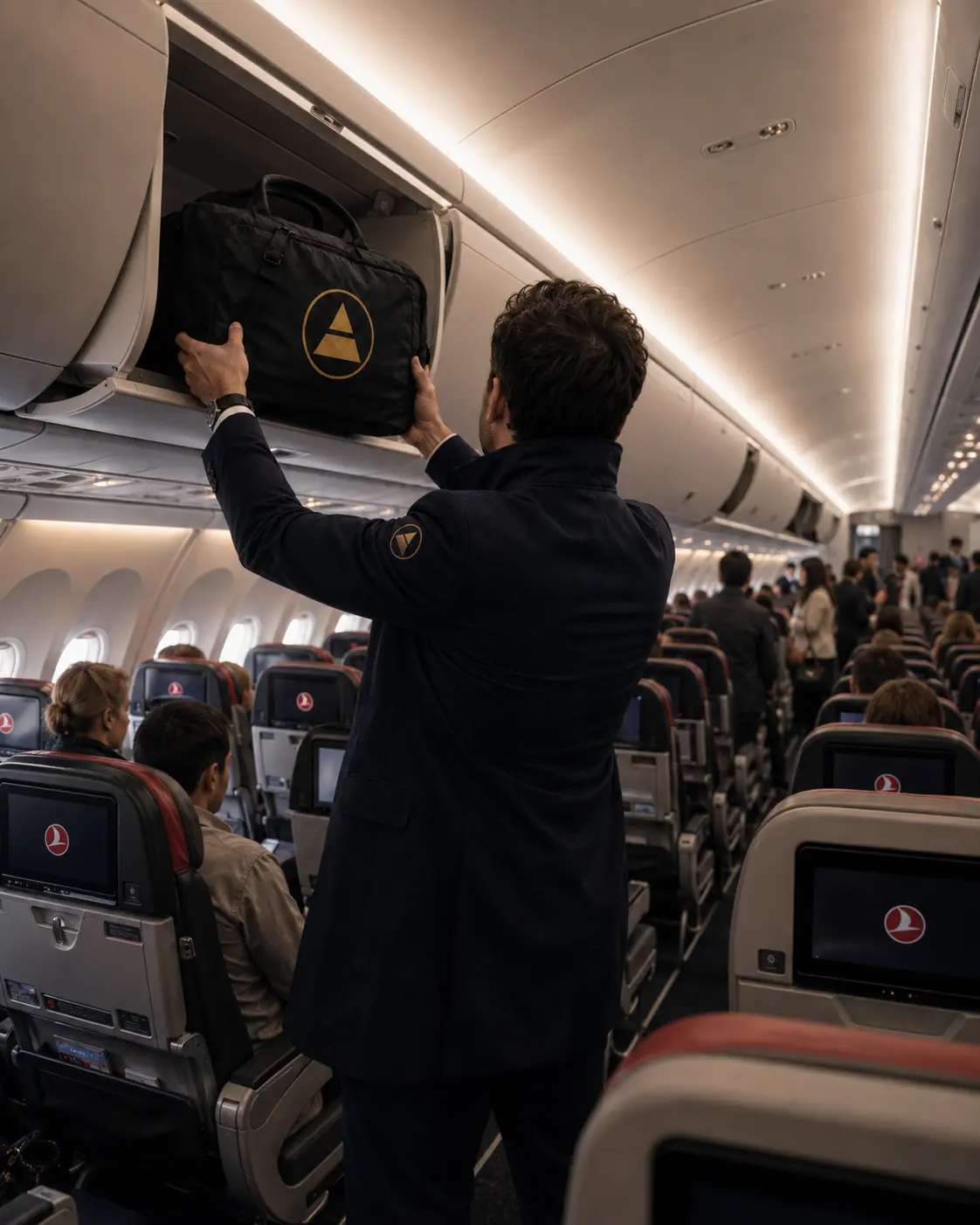
- It fits a bagUp to ~30 kg, within cabin or checked dimensions.
- A seat leaves before a jet couldA direct flight in three hours beats any positioning.
- Custody mattersOne pair of eyes from your door to the signature.
- The receiver is near a hubIt lands where passengers land; the last leg is short.
What travels
Small, expensive to be without, needed at a named hour.
Who sends it
What actually travels in a courier's bag.
The industries that call the desk most often, and the items they send.
- Documents that must be originals
- Executed contracts with wet signatures, certificates and licences, tender files, customs and trade originals — when the sender insists on one named pair of hands. Routine document shipments move faster and cheaper as air freight.
- Automotive
- ECUs and control units, sensors, PCBs, wiring harnesses, injector parts, prototypes, single-batch components.
- Airlines, MRO, AOG
- Avionics modules, sensors, valves, control units, line-replaceable parts, tooling.
- Machinery & plant
- PLCs, servo motors, inverters, boards, bearings, valves, pump and CNC parts, robot spares.
- Electronics & semiconductor
- Chips and wafers, photomasks and reticles, processors, server and telecom modules, prototypes.
- Medical & life sciences
- Devices, diagnostic and laboratory equipment, spares, and compliant clinical shipments in validated packaging.
- Data, broadcast & media
- Encrypted drives, rushes and masters, camera bodies and lenses, broadcast modules.
- Fine art & high value
- Works on canvas and paper, small sculpture, watches, jewellery and stones, garment samples before a show.
Freight forwarders use this desk under their own name too. Whether a specific shipment can travel is decided case by case — commodity, declared value, the customs regime at both ends, airline rules and insurance terms all have a say. Cultural property and permit-controlled goods only once the permits are in hand.
Where it goes
The corridor an OBC actually covers.
A courier flies where passengers fly, so the reach is the scheduled network — not a fleet. Our most-worked sectors from Istanbul, with the flying time only.
Flying time only. The door-to-door figure depends on where the part sits now, how far the receiving point is from the airport, and which channel customs sends it through — so the desk asks for your hour and works backwards.
How a mission runs
Istanbul to Frankfurt, hour by hour.
A worked example, not a past job dressed up as a case study — so you can see where the hours go and which of them are yours to shorten. There is no tracking map; there is a named coordinator and a message every time something changes.
Two of those lines move. If your paperwork is ready when you call, the gap between 08:12 and 10:05 shrinks to minutes; if the receiving site is two hours from the airport rather than forty minutes, the last line moves the other way.
Who carries it
A stranger is holding your part.
- Identity and right to travel — passport checked against the person, visas verified for that exact route and date.
- Criminal record certificate — requested before a first mission. No certificate, no mission.
- Briefed per mission — what the item is, what it is worth, what customs will ask.
- Signature at both ends — the chain of custody is a document, not a promise.
Limits
What we will not do.
- Undeclared goods — hand-carry is a speed technique, not a customs bypass.
- Most dangerous goods — lithium cells above threshold, aerosols, flammables. Declare contents; the desk validates first.
- Cash and bearer instruments — not carried, on any route, at any price.
- Beyond one person's bag — above ~30 kg the honest answer is a freighter or a charter, and we say so.
Questions
What clients ask.
How does customs work for a hand-carried commercial part?
It is declared — properly. Depending on route and value, the courier clears through the red channel with a commercial invoice, or the desk prepares formal export/import entries in advance.
Who pays the duty and import taxes?
Normally the receiver, unless you and the sender agree otherwise before departure. What a hand-carry changes is the timing, not the liability: the assessment happens at the counter, in front of the courier, rather than days later in a warehouse. The amount depends on how the goods are declared — commercial consignment, temporary import for a repair or exhibition, or personal effects — and on the destination's own thresholds. We tell you which regime applies before the courier is booked. We do not guess a figure on a web page.
Can dangerous goods travel OBC?
Mostly no: passenger-aircraft rules are strict, and lithium batteries above thresholds, liquids and aerosols are frequent blockers. Declare the exact contents; the desk validates before a courier is booked.
Can you take it if it is very valuable?
Often, and that is much of the work — but value changes the questions. Declared value drives the customs channel, the insurance terms and sometimes whether an airline will accept it in the cabin. Tell the desk the real figure at the start rather than at the airport.
Can a private person use this, or is it only for companies?
Both, though most missions are commercial. If something of yours is stuck in another country the method is identical; what changes is the customs side, because without a commercial invoice personal effects are declared differently and duty may apply on arrival.
Can someone accompany my pet on a flight?
Yes — a small cat or dog can travel in the cabin with a passenger on most airlines, larger animals in the hold on the same flight. But this is animal transport, not a courier job, and the paperwork decides it: microchip, rabies vaccination and often a titre test, a veterinary health certificate valid for the travel window, an IATA-compliant carrier, the destination's import rules, and an airline that accepts that species and size on that route and date. Some of it takes weeks, not hours.
What if the part is too big for a courier?
Then we say so on the first call. Above one person's baggage the comparison moves to next-flight-out freight or a charter, and the desk prices whichever actually makes your deadline.